Office Chair Failures and Testing Chairs to Determine Compliance with Industry Standards
By John L. Ryan, P.E. / First published March 2013

We are often contacted regarding various types of chair accidents, including chair collapse and tipping accidents. Some of these accidents can be due to connection failures such as bolt, screw, or weld failure, or a manufacturing or material defect. Many chair accidents however are due to design flaws that result in chair instability, catastrophic structural failure, or component failure. Our standard protocol in these cases is to test an exemplar chair per industry standards, which in this case is ANSI/BIFMA X5.1. This issue of
Chair Types
The standard groups office chairs into one of three types. Type 1 includes tilting chairs where the seat and backrest both tilt rearward together.
Type 2 chairs are fixed seat angle chairs that have a tilting backrest. Type 3 chairs are fixed seat angle and fixed backrests chairs, whether on rollers or with fixed legs.
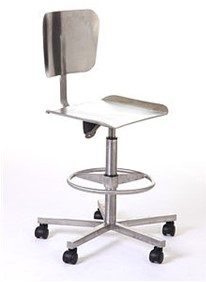
Type 2 Fixed Seat Angle Chair with Tilting Backrest
Chair Testing Criteria
Backrest Strength Test
This test is designed to test the ability of a chair to withstand forces and stresses placed on it from the chair occupant leaning backwards against the backrest. This is the test to perform on chairs involved in accidents where the backrest failed and tilted backwards.
In this test, the base of the chair is constrained, and a load of 150 pounds or 200 pounds depending on the chair type is applied to the backrest at about 16 inches above the seat. The load is applied using a distribution device, preferably one that conforms to the shape of the seat, approximately 12 inches x 3.5 inches x 0.5 inches. There must be no loss of serviceability to the chair after holding the load for one minute. A proof load of 250/300 pounds is then applied in the same manner, with loss of serviceability being allowed as long as there is no significant reduction in the structural integrity of the chair.
Base Test
This test is to ensure that the base of a pedestal chair can withstand loads that will be applied to the chair, including a factor of safety for dynamic loading that occurs when someone drops into the chair as opposed to slowly lowering into it. If an accident results in a broken chair base, this test will help determine if there is a design flaw that resulted in the failure. To perform this test, all seating components are removed from the base including casters. A force of 2500 pounds is applied to the center of the chair base for one minute. Acceptance criteria is that no significant loss of structural integrity will occur after removal of the load.
Drop Tests
Drop tests are performed to insure the ability of a chair to withstand heavy impact forces. In this test a 225 pound load consisting of a bag with sand is raised six inches above the seat and released. No loss of serviceability can occur with this load. A proof load of 300 pounds is then dropped onto the seat, with no significant loss of structural integrity.
Stability Tests
Many chair accidents involve a chair tipping over resulting in injuries to the occupant. It is imperative in these accident cases to determine if a chair meets stability requirements. One test is the Stability Test found in the ANSI/BIFMA X5.1 standard. If a chair cannot meet the criteria in this test, it could be found to be unreasonably dangerous, and the cause of the accident.
Many chairs have various adjustments to them. Stability tests should be performed with the test in the least stable position to determine standard compliance. Placing a chair in the least stable position may include raising the seat and backrest height, reducing the tilt mechanism tension to its minimum, positioning the seat as
A 173 pound weight is placed on the center of the seat of the chair, and the chair prevented from sliding by affixing 1/2 inch blocks to the test platform. These blocks should not interfere with the ability of the chair to tip. A rearward force is then applied to the backrest of the chair at a position near the top of the test weight in the seat. The force is increased until the front legs or wheels begin to lift off of the test platform. In order to meet standard criteria, the chair should be able to withstand 20 pounds of force for chairs that are Type 1 or Type 2. Type 3 chairs should be able to withstand 35 pounds.
Typically forward chair instability does not cause as many accidents as rearward. There are forward chair stability requirements that chairs can be tested to if an accident of this type occurs. Additional stability testing criteria may be needed to insure that the chair design is adequate.
Leg Strength Test
Chair legs often fail, resulting in the collapse of the chair and the occupant being thrown to the ground. The leg strength test can
I Have a Client with Injuries from a Chair Failure - What Do I Do Now?
Like most accidents involving potentially defective products, it is important to preserve the evidence of the chair involved in the incident. This may not always be possible since some time typically has passed by the time an accident victim seeks an attorney. The chair is likely to be owned by a third party, who may or may not be helpful. Take whatever steps necessary to have the chair preserved. The next step is to get some photographs of the subject chair, particularly of the damage to the chair, and email them to us at info@mase.pro. We will take a look at the damage and let you know what the next step should be. If the chair is still available, much information can be found out by an inspection of the chair. There may be manufacturing or material defects that led to the chair failure. Testing of an exemplar per chair standards discussed in this Clues is the next step to establish a design defect that caused the accident.
Give us a call at (855) 627-6273
Or email us at info@mase.pro